


Overview
It’s not every day you get to design a product that changes not just how users work, but how your company sees its future.
Elementor made it easy to build. But in late 2024, we asked a tougher question:
What if the real friction starts before building even begins?
We discovered that planning a website, defining its structure, goals, and content, was still messy, slow, and deeply manual. Most users were stuck repeating the same setup rituals, jumping between tools, or working without a clear vision.
We saw an opportunity to flip the script.
This is the story of how we created AI Site Planner – a tool designed to streamline the pre-build phase, help creators start smarter, and redefine what “getting started” should feel like.
The impact
In just a few months, AI Site Planner reshaped the way web creators begin their projects – turning a manual, repetitive setup process into an intelligent, user-first experience. By grounding the flow in UX best practices and pairing it with AI acceleration, we cut setup time by up to 10×.
The response was immediate: 84% CSAT in the first month, steady satisfaction over time, a measurable boost in retention, and the confidence to scale AI investment across the company.
The friction we couldn’t ignore, and the opportunity we couldn’t miss
In dozens of conversations with web creators, a recurring pattern emerged:
everyone had their own way to plan, and none of them felt quite right.
Some scribbled their structure on paper. Others prototyped in Figma, only to rebuild it block by block inside the editor. Many skipped planning altogether and started building blindly, one page at a time only to hit dead ends, backtrack, and burn hours in revisions.
The cost?
Disjointed sites, wasted time, and an exhausting, repetitive setup process that every user had to face every. single. time.
What we uncovered was clear:
The planning phase wasn’t just underserved – it was broken.
For Elementor, this was more than a UX issue. It was a growth opportunity.
By helping users begin with clarity and structure, we could reduce friction, accelerate time-to-value, and bring new creators into the funnel with confidence.
Designing the strategy behind the solution
We didn’t want to build just another AI gimmick. We wanted to solve a real problem in a way that scaled intelligence, not effort.
So instead of asking users to write a magical prompt and hope for the best, we started with a harder question: What makes a great brief?
We realized that the key to powerful outputs lies in smart inputs. We focused the UX on helping users define their goals, content, and structure through a guided set of contextual questions, not walls of text.
From there, the system generated a sitemap and wireframes rooted in real intent.
As Product Design Manager, I led the vision and user experience, working closely with the AI team and our CPO to position this as a strategic shift, not just a feature. We moved fast, validating assumptions through concept iterations, MVP testing, and early-access feedback from power users.
The goal was simple: help users start faster, with more clarity and trust the process from the very first step.
To do that, I had to design a flow in which AI accelerates while users remain in control.
Building a flow that feels human, even when it’s AI
Translating our vision into a product meant solving one of the hardest UX challenges in AI: How do we help users generate better results, without making them feel like they’re doing all the work?
I focused on creating a natural, encouraging, and deeply human flow:
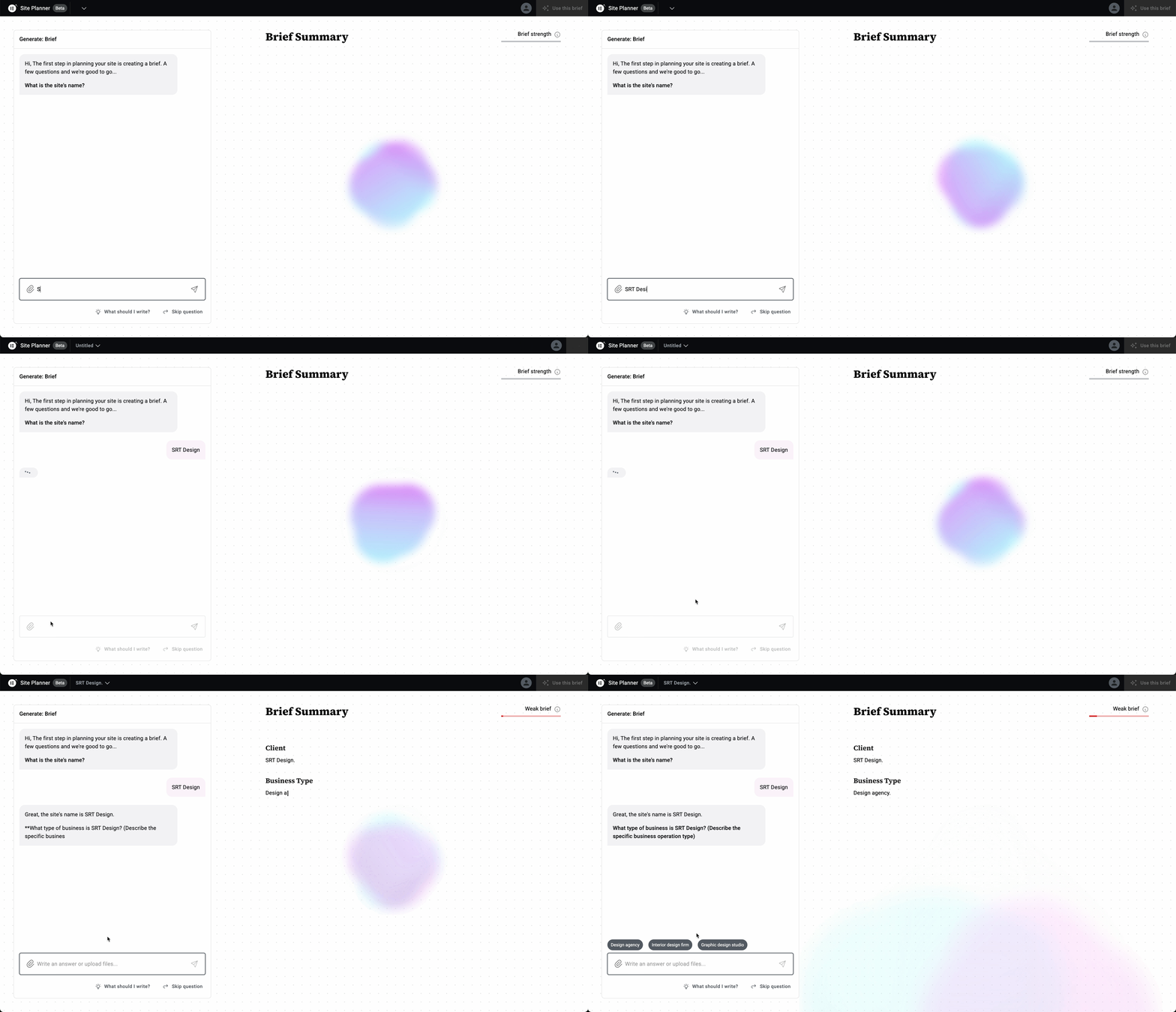
- Bite-sized steps
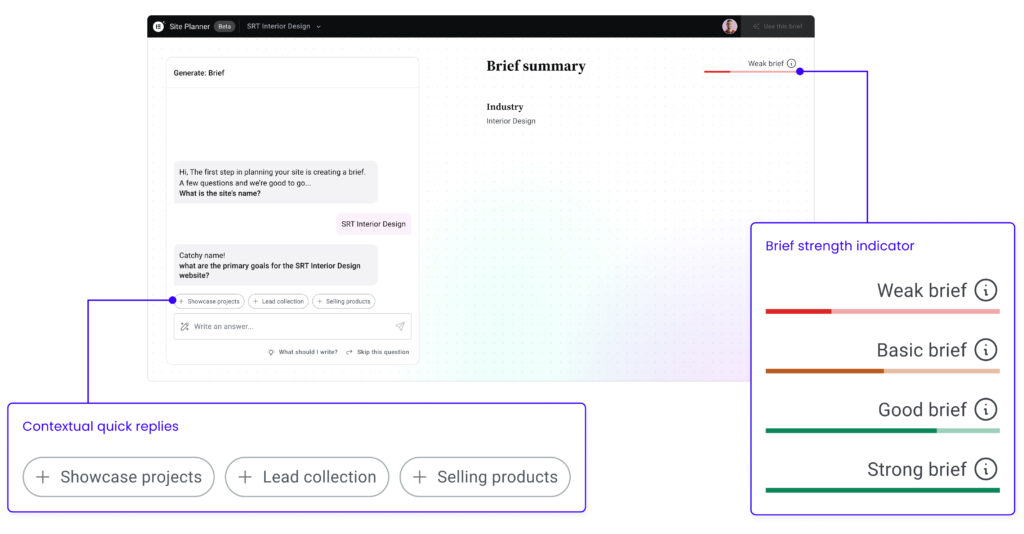
Instead of overwhelming users with forms or long prompts, we broke the briefing process into clear, easy-to-answer steps. One focused question at a time. - Contextual quick replies
To reduce friction, users could choose from smart, AI-generated suggestions, making it easier to respond and harder to get stuck. - Brief strength indicator
A subtle gamification element helped users see how strong (and useful) their brief was becoming, encouraging deeper input without pressure. - Microinteractions that signal progress
A subtle gamification element helped users see how strong (and useful) their brief was becoming, encouraging deeper input without pressure. - Always editable
Even after generating a full sitemap and wireframe, everything stayed editable. Users could delete, tweak, or add, reinforcing that AI assists, not decides.
Testing fast, learning faster
To bring this experience to life, we moved fast, but never blindly.
We released a focused MVP to ~3,000 early access users, designed to test not just functionality, but user behavior and emotional response. Alongside usage analytics, we ran white-glove sessions with power users: 1-on-1 interviews, live walkthroughs, and deep usability feedback.
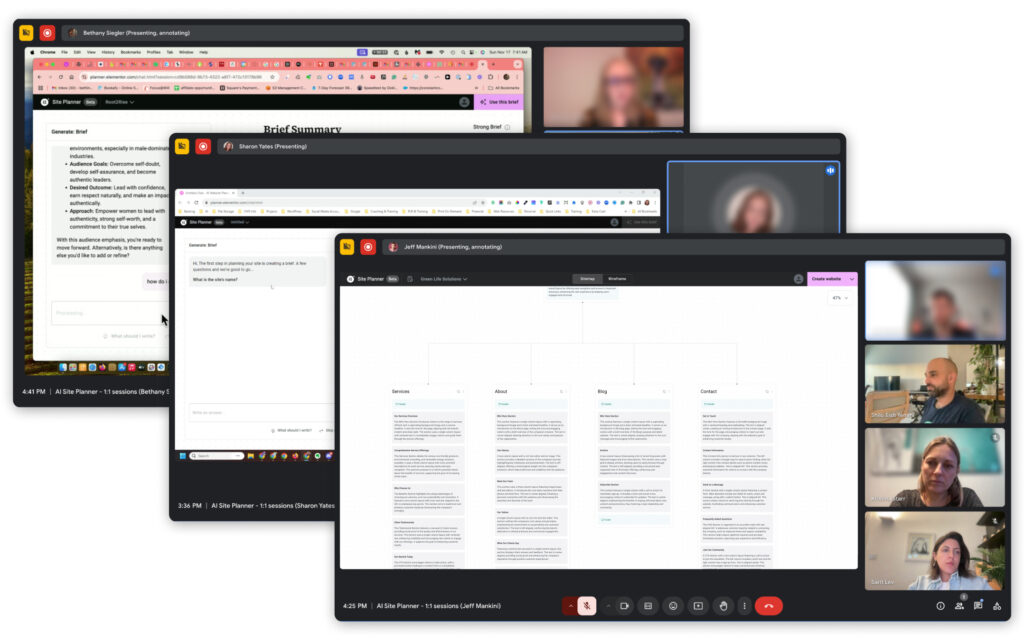
What I learned confirmed my instincts:
- Users loved the speed, but only when paired with clarity.
- They appreciated the AI, but only when they felt in control.
- The guided brief wasn’t just “nice to have” – it became the differentiator.
Their feedback shaped what made it into the MVP and what we postponed for later roadmap stages.
This constant iteration loop helped me stay focused on value, not vanity. I wasn’t chasing perfection. I was designing confidence, one insight at a time.
What success looked like
From the start, I knew we needed to measure not just usage, but experience.
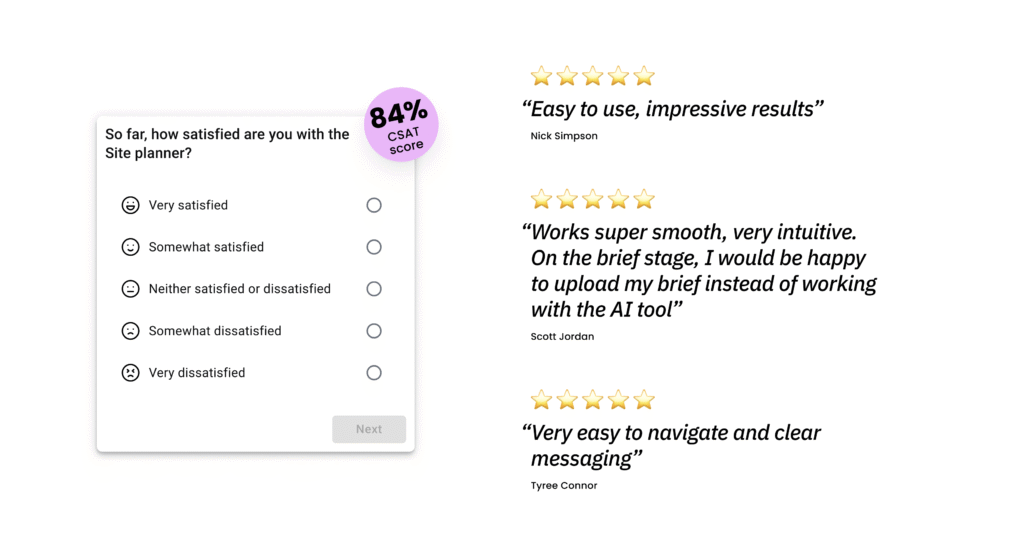
We chose CSAT as our leading metric and built it directly into the flow.
To stay close to the voice of the user, we routed all feedback into a dedicated Slack channel, where our team could see responses in real time, spot bugs faster, and categorize insights as they came in.
About two and a half weeks after launching early access, in January 2025, we officially released AI Site Planner.
The sentiment was overwhelmingly positive, and the numbers backed it up:
CSAT hit 84% in the first month and continues to average around 83%, three months later.
But this wasn’t just a spike. It was a shift.
Users described the experience as smooth, intuitive, and empowering. They finally had a way to start projects faster, with more clarity and less friction.
Internally, it validated our belief that UX-led AI could unlock meaningful growth and helped scale our AI team to pursue even more high-impact tools.
For me, it was a milestone in designing for trust. Because when users feel guided, not replaced, that’s where real product momentum begins.
What’s next?
AI Site Planner was never meant to be a standalone tool – it was the starting point of a mindset shift.
Since launch, we’ve seen how a smarter, more structured beginning can transform the rest of the website-building journey. Now, I’m focused on extending that clarity and intelligence deeper into the flow, from design decisions to content to optimization.
This project didn’t just redefine how users get started. It reshaped how we, as a company, think about user empowerment, AI collaboration, and the future of web creation.
And we’re just getting started.
Key Takeaways
- Real user pain was hiding in the pre-build phase – planning was slow, repetitive, and scattered across tools.
- AI alone wasn’t enough – UX-led thinking turned automation into a guided, empowering experience.
- Smart input = better output – helping users craft strong briefs led to more relevant and satisfying results.
- Speed didn’t win on its own – clarity, control, and confidence were just as critical.
- Impact was real – 84% CSAT, faster workflow, improved retention, and AI validated as a strategic driver.
